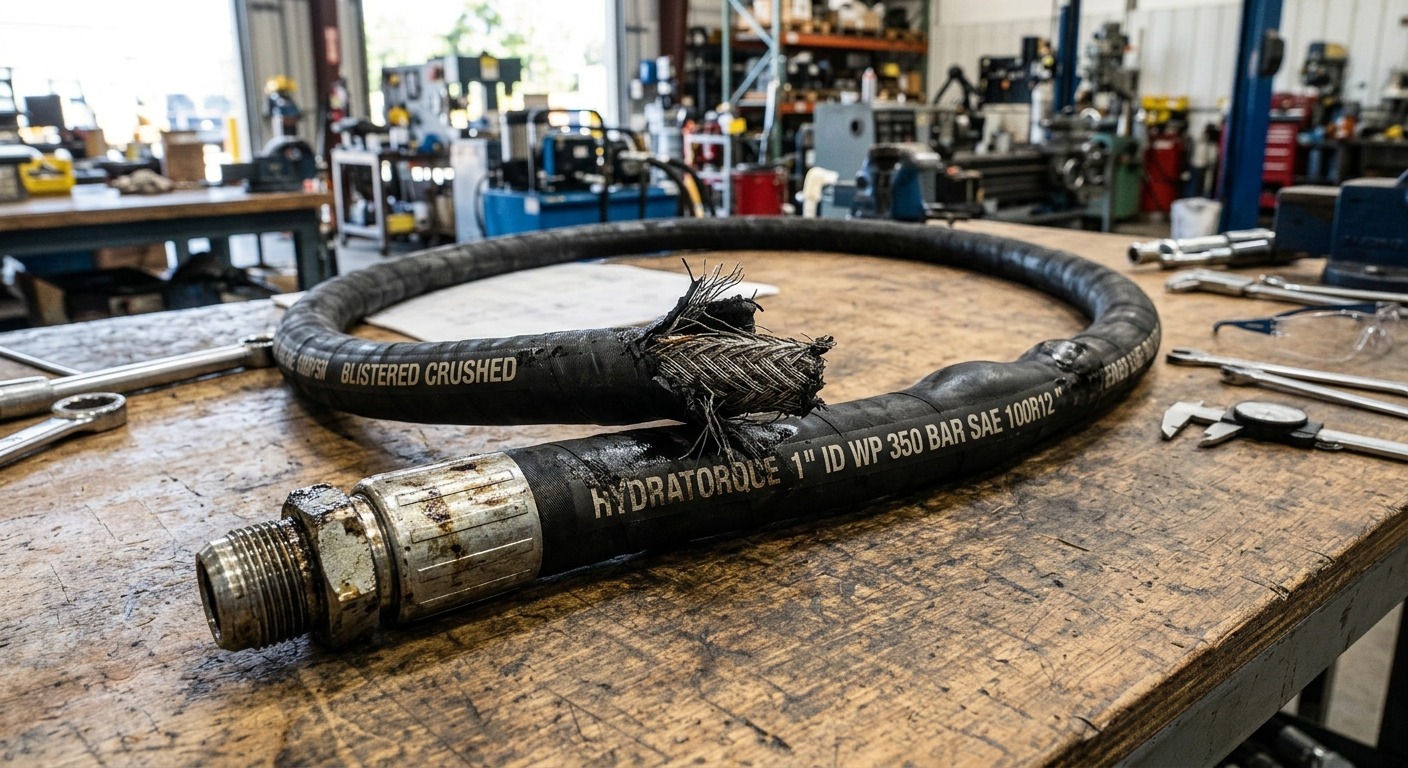
Hose failures are rarely random. When a hydraulic or industrial hose bursts, leaks, or detaches, it is almost always the result of a specific operational or environmental stressor. Identifying the root cause of failure is essential not only for immediate repair but also for preventing repetitive downtime and ensuring workplace safety.
Here is a detailed look at the most frequent causes of hose failure and how to recognize them.
Incorrect Specifications
One of the foundational steps in hose safety is ensuring the correct hose was selected for the job. Two common specification errors include:
- Incorrect Size: Using a hose with an inside diameter that is too small increases fluid velocity, causing excessive heat generation, system inefficiency, and pressure drops. A hose that is too large can be difficult to route and may not meet system requirements.
- Incorrect Pressure Rating: If the maximum system operating pressure exceeds the hose’s rated working pressure, failure is imminent. Choosing a hose without verifying the pressure capacity guarantees premature rupture.
Dynamic Pressure Loads
Even if a hose is rated correctly for the average working pressure, dynamic conditions can stress the reinforcement layers over time.
- Pressure Spikes: Sudden surges of pressure, far exceeding the normal working pressure, can fatally weaken the hose. A hose must be selected to handle the peak pressures of the system.
- Repeated Impulse Cycles: Hydraulic systems often operate with rapid, frequent pressure changes. Each time the pressure cycles, the hose reinforcement is stressed. Without the correct wire-braided or spiral-wound construction to handle these high-frequency pulses, the hose will experience fatigue failure.
Temperature Extremes
Hoses are designed to operate within specific temperature ranges. Exceeding these limits weakens the hose material properties.
- Excessive Heat: High operating temperatures (either from ambient air or the fluid being conveyed) can cause the inner liner to harden and crack. Heat-baked hoses become brittle and will quickly fail when flexed.
- Excessive Cold: Extremely low temperatures make the hose material inflexible. When a cold hose is exposed to system stress or movement, the liner can crack, leading to leaks.
Chemical and Fluid Interaction
A hose must be chemically compatible with the media it conveys and the environment in which it operates.
- Incompatible Fluid: Using a hose that is not compatible with the specific hydraulic fluid, chemical, or lubricant will degrade the inner tube. This often manifests as swelling, softening, or blistering, which ruins the hose structure.
- Contamination: Abrasive particles within the fluid will erode the inner tube over time. External contamination, such as chemical spills or ozone exposure, can also attack the outer cover, compromising the entire assembly.
Mechanical Stress and Installation Issues
Hoses are often subjected to physically demanding environments. Improper installation and routing account for a significant percentage of premature failures.
- Abrasion: Rubbing against machinery, equipment edges, other hoses, or rough surfaces is a major cause of failure. Friction wears down the outer cover, exposes the reinforcement, and eventually results in a burst.
- Poor Routing, Tight Bends, or Twisting: Bending a hose beyond its minimum bend radius stresses the reinforcement and inner tube. Similarly, routing a hose so that it is twisted restricts flow and strains the core layers. Both conditions drastically reduce hose lifespan.
- Inadequate Hose Length, Clamping, or Allowance: Hoses can change length under pressure (expand and contract). If a hose is cut too short, lacks adequate clamping, or does not allow for equipment movement, it can be pulled taut and fail at the coupling crimp.
Assembly and Inspection Errors
A hose assembly is only as strong as its connections and the frequency of its inspections.
- Incorrect Fittings, Tooling, or Crimp Specifications: For a safe and leak-free assembly, the hose, fittings, and crimp tools must be compatible. Using mismatched components or improper crimp specs often leads to the fitting detaching—one of the most dangerous forms of hose failure.
- Unidentified Normal Wear: All hoses eventually wear out. A major cause of failure is normal degradation (cracking, hardening, cover wear) that goes unnoticed simply because the system was not inspected regularly.
Conclusion and Best Practices
Hose failure analysis is critical. When a failure occurs, don’t just replace the hose and carry on. Investigate why it failed.
- Crucial Note: Repeated hose failures are a clear warning sign. If the same type of failure happens consistently on the same machine or circuit, it should trigger a complete review of the system design and operating conditions to address the root cause. This may include reviewing pressure ratings, temperature specs, routing, and component compatibility.
Understanding these common causes is the first step toward building a safer, more reliable fluid power system.